Newsletter 02 · August 2026
Aging Begins With a Broken Signal: The Silent Loss of Fast Motor Units
Introduction
This is my personal theory on aging…something I’ve built over decades of training, observation, and research, and recently put together in a published preprint (Ruggia, 2025). It challenges the way aging is usually explained and raises a simple question: what if we’ve been looking in the wrong place this whole time?
Right now, the entire longevity space is focused on what’s happening inside your cells. You hear about NAD+, telomeres, mitochondria, and all kinds of supplements that claim to slow or even reverse aging. There’s a massive industry built around fixing these tiny, microscopic problems, with the belief that if you repair the cell, you can fix aging.
But that way of thinking is backwards.
What you’re seeing at the cellular level is not where aging starts; it’s what shows up later. It’s the result, not the cause. We’ve been trained to look at the damage and assume that’s where the fire began, when in reality, it’s just the smoke.
The real problem starts somewhere else.
Aging is not just a cellular issue. It’s a nervous system issue. It begins when your body starts losing control, not when your cells suddenly fail.
Even while you still feel strong, healthy, and in your prime, your nervous system is already starting to pull back from its most powerful tools, the fast motor units. These are what give you speed, power, quick reactions, and sharp, controlled movement. They’re a big part of what makes you feel young.
And this process doesn’t wait for disease. It doesn’t show up on a blood test. It happens quietly, in the background, long before most people notice anything is changing.
But once it starts, everything else begins to follow.
The 25-Year-Old Inflection Point
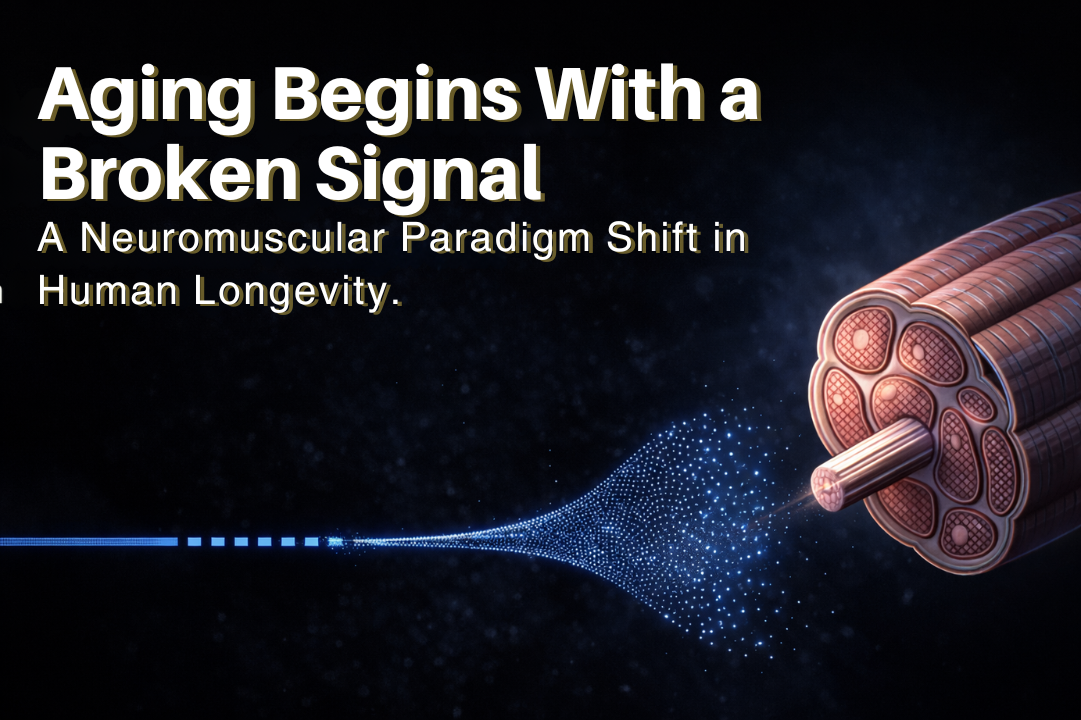
The real starting point of aging doesn’t happen when you’re old; it starts much earlier. Most people think aging begins when they feel weak or slow, usually in their 70s or 80s. But the truth is, the process begins decades before that, and most people don’t even notice it.
Around the age of 25 to 30, your body starts to lose its fastest and most powerful motor units. This isn’t a theory. It happens to everyone, no matter how healthy, active, or fit they are.
What makes this even more important is that the loss doesn’t happen evenly across the body.
The first areas to be affected are usually the legs, especially the muscles that control speed, balance, and quick reactions. These are the muscles you rely on for things like sprinting, changing direction, catching yourself when you slip, or staying stable on your feet.
That’s why the earliest signs of aging are not always obvious weakness, but small changes in movement. Your reactions get a little slower. Your balance isn’t as sharp. Your footwork loses some of its quickness. Movements that used to feel automatic start to feel slightly delayed.
At first, it’s subtle. Most people don’t think anything of it. But over time, it adds up.
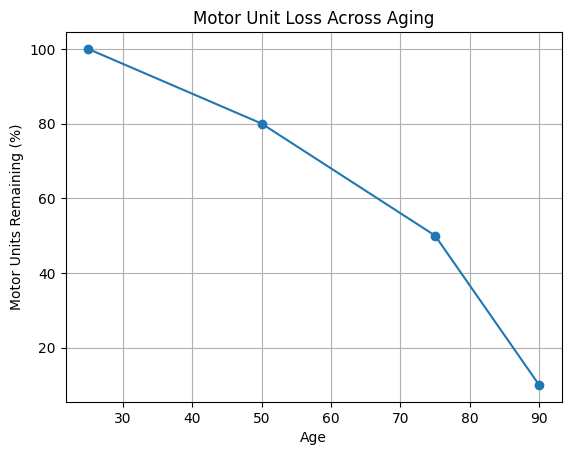
By around age 75, the average person has lost about half of their motor units. In later years, that loss can go past 90% (Piasecki et al., 2016). By the time someone actually feels old, most of the system that once made them fast, powerful, and precise is already gone. What’s left is a slower, less responsive system trying to make up for what’s been lost.
This also changes how we should look at things like VO₂ max, reaction time, and loss of power. These are usually treated as separate problems, but they’re not. They all come from the same place.
They are the result of the nervous system slowly reducing how much control it has over the body. What looks like a bunch of different problems is really one process happening underneath it all.
So the question is not whether decline happens. The question is why it begins so early, while everything else in the body still appears to be working at a high level.
And that’s where the standard explanation starts to fall apart.
The Upstream Origin: Why the "Hallmarks" Fail the Timeline Test
Most of today’s aging science says the same thing: aging starts in your cells. They blame things like damaged DNA, failing mitochondria, shortening telomeres, and other forms of cellular wear and tear. That has become the standard story. According to that view, your body gets old because your cells start breaking down.
But there’s a big problem with that story.
A lot of those cellular changes can be found very early in life. Some are there from the beginning. Yet young people still grow, heal, move fast, build strength, and perform at a high level. Human beings usually reach their best years of speed, agility, and power somewhere between 20 and 30 (Gustafsson and Ulfhake, 2024). And that’s the exact same window when fast motor units already start to disappear.
That should make people stop and think.
If the so-called hallmarks were really the true starting point of aging, then why are people still getting stronger, faster, and more powerful while those things are already present? Why does real physical decline begin only when the nervous system starts pulling back from the body’s fastest and most powerful motor units?
That’s why I believe the cell-first model has the order backwards.
The real change starts when the nervous system begins to lose control. Once that happens, everything below it starts to slide. The muscles lose their sharpness. Power drops. Reactions slow. Movement gets less precise. Then, over time, the cellular problems become more obvious. In other words, the damage people focus on may not be the cause of aging at all. It may be what shows up after the real process has already started.
This idea was pointed out years ago by researcher J. Lexell (Lexell 1995), who said that normal aging can be seen as a slow nerve-related process (neurogenic), and that the breakdown of the nervous system plays a major role in the loss of muscle and strength. That matters because it points the finger higher up the chain. Not at the cell first, but at the signal.
If the real problem starts higher up, at the level of the signal, then the next step is to understand what that signal is actually controlling.
And this is where most people misunderstand what muscle really is.
The Paradigm Shift
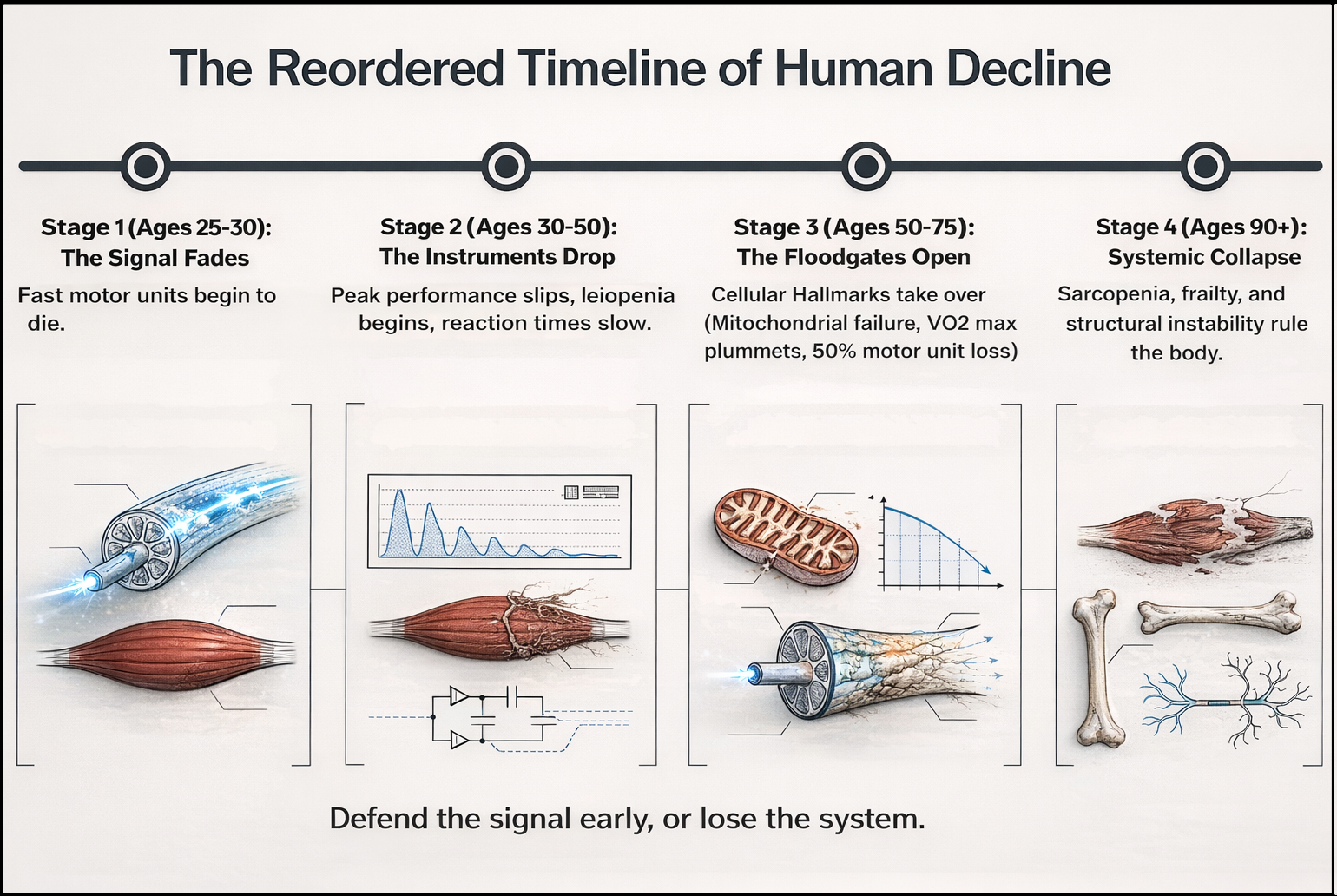
The Cellular Model (Downstream): This model says aging starts because the cells wear out. So it tries to fight aging by fixing the cell with supplements, drugs, and other treatments aimed at things like inflammation, mitochondrial problems, and DNA damage.
The Neuromuscular Model (Upstream): This model says aging starts earlier and higher up. It begins when the nervous system starts to let go of the body, especially the fast motor units. In this view, the cellular damage comes later. It doesn’t start the fire. It shows up after the fire has already begun.
The Hardware Problem and the Biomechanical Paradox
People are often told that muscle can be rebuilt at any age. And to a point, that’s true—you can build muscle size. But that’s not the real issue. The real issue is the “hardware” behind the muscle.
A motor unit is not just muscle, it’s the connection between the nerve and the muscle it controls. And that system does not rebuild the way people think. Motor neurons don’t
simply divide and grow back. Once they pull away and disappear, they are gone. That means you’re not just losing muscle—you’re losing the actual control system that drives it.
This creates a major problem for anything claiming to reverse aging.
Even if you could grow new muscle using stem cells or advanced treatments, you would still be missing something critical. You wouldn’t be restoring the “learned intelligence” of that system—the timing, the coordination, the way different motor units work together. This is what’s often called muscle wisdom and common drive. It’s the ability of your nervous system to fire the right units, at the right time, in the right sequence, based on years of experience.
Think of it like a master violinist. You can replace the strings on the violin, or even replace the hand with a prosthetic, but you cannot replace the years of skill, timing, and control built into that person. Once that is gone, the performance is not the same. The instrument might be new, but the mastery is lost.
The same thing happens in your body. Once the original firing patterns are gone, you don’t just lose strength, you lose precision, timing, and control.
Now this leads to the biomechanical paradox.
As the nervous system starts to pull back, the body itself begins to adapt to lower levels of force. Your tendons, ligaments, and bones start adjusting to doing less. Over time, they become weaker, less organized, and less able to handle high forces.
So now you have a loop. The nervous system pulls back because the body can’t handle high output anymore. At the same time, the body becomes weaker because the nervous system is no longer pushing it. Each one feeds the other. And this creates a serious problem.
If you were to suddenly give a 75-year-old the power of a 25-year-old, without rebuilding the structure of their body first, it wouldn’t make them young again. It would likely lead to injury. The system underneath is no longer built to handle that level of force.
So the problem is not just losing muscle. It’s losing the entire system that produces, controls, and safely handles force. But losing the connection is only part of the problem.
The deeper issue is what disappears along with it.
The Irreversible Deletion of Neural Software
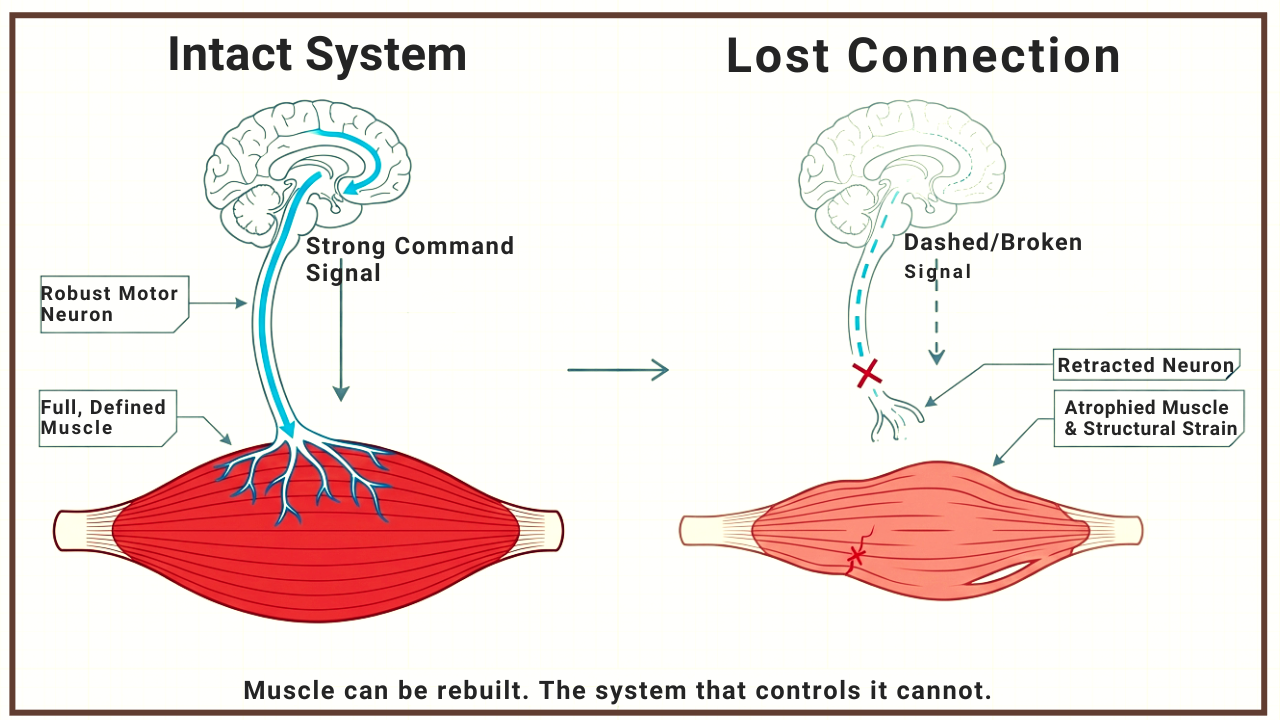
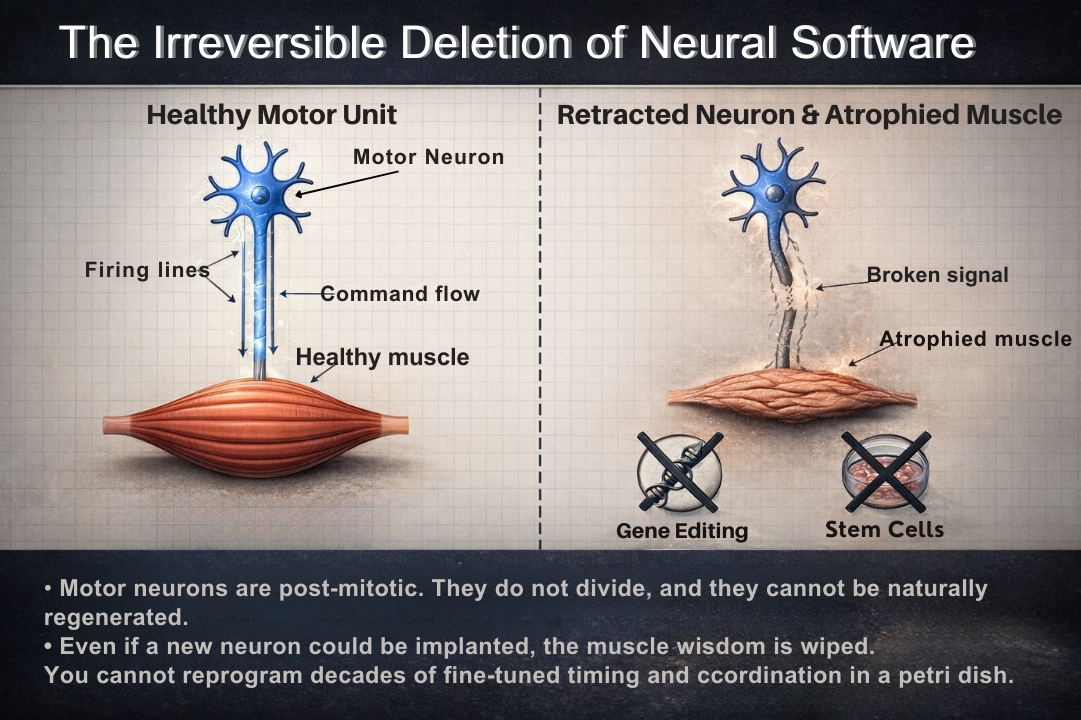
This image shows something most people completely miss when they think about aging, and it goes straight to the core of what is actually happening inside the body.
On the left side, you are looking at a healthy motor unit. The signal from the neuron travels clean and strong down into the muscle. The communication is clear, the timing is precise, and the muscle responds exactly the way it is supposed to. Everything is connected, everything is working together, and this is what a fully functional system looks like when it is still intact.
On the right side, you see what starts to happen over time. The neuron begins to pull back, the connection weakens, and the signal becomes broken. Once that signal starts to fade, the muscle does not just stay the same, it begins to shrink and lose its ability to function properly. This is not because the muscle failed on its own, it is because the command is no longer reaching it the way it used to.
This is where most people get it wrong. They think the problem starts in the muscle, so they focus on rebuilding tissue, using stem cells, or trying to fix things at the cellular
level. But the real issue is not just the structure, it is the system that controls that structure.
Motor neurons are post-mitotic, meaning that they do not divide, and once they pull away, they are gone. Neither gene editing nor stem cell therapy can bring them back. Even if you could somehow replace them, you would not be restoring what was there before. What is being lost is not just a physical connection; it is what I call the neural software.
This includes muscle wisdom, common drive, and precise firing patterns that have been built over years of movement, timing, coordination, and repetition. This is learned through experience, refined over time, and unique to each individual. You cannot recreate that in a lab, you cannot grow it in a dish, and you cannot program it back into the body once it is gone.
It is like taking a master musician and wiping out everything they have learned. You can hand them a brand new instrument, but you cannot instantly give them back the timing, the feel, and the control they spent decades building.
Once that neural software is erased, it is gone. That is why this is not just a muscle problem, and it is not just a cellular problem. It is a command problem. It is a system problem. And everything starts to change the moment that signal begins to break.
So if this system cannot be rebuilt once it’s gone, the only question that matters is:
What keeps it alive in the first place?
Movement as "Neural Food"
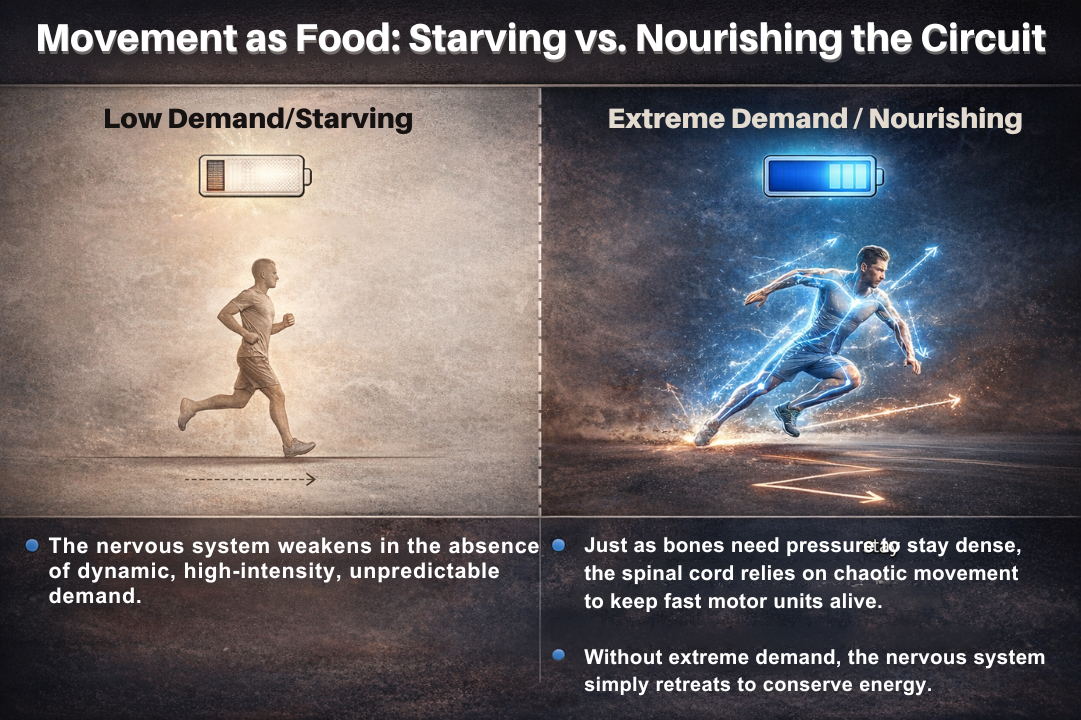
If your nervous system is running your body, then it needs the right kind of input to stay sharp. Think of it like food. If you don’t give it what it needs, it starts doing less. And not all movement feeds it the same way.
Repetitive Motion (Neural Habituation): When you do the same movement over and over, like jogging or cycling at a steady pace, your nervous system gets used to it. It figures out how to do it with less effort and less communication. That’s what neural habituation means: your system gets too comfortable and stops working at a high level. This is why even high-level endurance athletes still lose fast motor units. They’re active, but they’re not forcing their system to use its most powerful units. So over time, that part of the system fades.
Neural Food (Chaos and Speed): If you want to keep your nervous system alive and active, you need to challenge it. You need speed, quick reactions, and movements that are not predictable. That’s what feeds it and keeps it from shutting things down.
To actually keep this system going, you need specific types of movement. Explosive breathing, which forces the fast motor units of the diaphragm to work. Chaos cuts on
uneven or unstable ground force your body to react without thinking. Torque-based movements push your body to create and control rotation.
These are not just exercises. They are signals. They tell your nervous system, this part of the body is still needed, don’t turn it off.
Beyond Sarcopenia: The Diagnostic Warning of Leiopenia
For years, people have focused on sarcopenia, which means the loss of muscle mass. But that shows up later. It is not the first sign of aging. It is more like the end result.
The earlier warning sign is something I call leiopenia. This is a term I created to describe what really starts to fade first, your smooth and fluid movement.
The word comes from the Greek words leios, meaning smooth, and penia, meaning loss. Leiopenia is the loss of smooth, controlled movement. Before you lose strength, before you struggle to stand or move, you start losing the quality of how you move.
Your movements stop feeling clean. They stop feeling natural. You lose the flow.
You start to notice small things. Your walking is not as smooth. Your coordination feels slightly off. Movements that used to feel automatic now feel a bit stiff or delayed. It is not that you cannot move; it is that you are not moving well anymore.
That is the real warning sign. If your movement starts to look jerky or robotic, it means something deeper is already changing. It means the system controlling your body is starting to pull back.
This is why finesse matters more than raw strength. Strength is just force. Finesse is control. It shows how well your nervous system is still communicating with your body.
And once that starts to fade, the rest will follow.
Conclusion: Defending the Conductor
The path to living longer is not in a pill that tries to clean up your cells. It comes down to protecting the system that runs your body in the first place, the connection between your brain and your body.
Most people are focused on fixing what’s happening at the surface, the cells, the tissues, the blood markers. But the real issue is the signal. If the signal starts to fade, everything else starts to break down after it.
Aging starts to speed up the moment your nervous system decides your body is not worth the energy anymore. When that happens, it begins to shut things down little by little.
Your job is to stop that from happening.
You have to give your body a reason to hold on to those systems. You have to move in a way that forces your nervous system to stay active. Fast movements, powerful movements, unpredictable movements, movements that make your body react and adjust. That is what keeps the system alive.
Because what you are really trying to protect is not just muscle, it is the intelligence behind the movement. That is what keeps you sharp, quick, and in control.
Your nervous system is deciding, every day, what it still needs, and what it can afford to lose. It doesn’t care about your intentions. It responds to what you actually do. If you move slowly, it adapts to slow. If you avoid challenge, it shuts down what you don’t use.
But if you demand speed, precision, and control… it holds on. This isn’t about staying active. It’s about staying capable because once the signal is gone, you’re not rebuilding it.
So the question is no longer theoretical.
What are you doing today to make sure your body stays worth keeping?
References
Gustafsson, T., & Ulfhake, B. (2024). Aging Skeletal Muscles: What Are the Mechanisms of Age-Related Loss of Strength and Muscle Mass, and Can We Impede Its Development and Progression? International Journal of Molecular Sciences, 25(20), 10932. https://doi.org/10.3390/ijms252010932
Lexell J. (1995). Human aging, muscle mass, and fiber type composition. The journals of gerontology. Series A, Biological sciences and medical sciences, 50 Spec No, 11–16. https://doi.org/10.1093/gerona/50a.special_issue.11
Piasecki, M., Ireland, A., Jones, D. A., & McPhee, J. S. (2016). Age-dependent motor unit remodelling in human limb muscles. Biogerontology, 17(3), 485–496. https://doi.org/10.1007/s10522-015-9627-3
Ruggia, T. (2025). The first to fall: Fast motor units as the hidden trigger of human aging OSF Preprints. https://doi.org/10.31219/osf.io/hw8v7_v1 -