Newsletter 01 · August 2026
Rethinking Aging: A Systems-Level Failure of Motor Units
A systems-level argument that aging is not simply muscle loss or wear and tear, but the progressive weakening of the neural systems that produce speed, power, coordination and movement.
Introduction
Most people think aging is a slow breakdown of the body. They believe muscles get weaker, joints wear down, and everything gradually declines over time. It sounds logical, and it is what almost everyone accepts as the truth.
But that is not what is really happening.
Aging is not just wear and tear. It is not just muscle loss. It is the breakdown of a system.
The human body does not operate in isolated parts. It functions as a connected network, where the brain, nerves, and muscles work together to produce movement. When that system is intact, movement is smooth, fast, and controlled. When that system begins to fail, everything starts to fall apart, even if the muscles themselves still look strong.
This is where most people are looking in the wrong place.
They focus on the muscle because it is visible. But the real problem is not the muscle. It is the system that controls it. To understand aging, you have to stop looking at isolated parts and start looking at how the entire system works together.
The Sprinter Paradox
Consider what can be called the “Sprinter Paradox.” There are elite master athletes who have spent decades sprinting and training for power at a very high level. They stay muscular, fast, and highly conditioned well into older age. But once they pass around age 80, many of them still follow almost the same pattern of motor unit loss as people who never trained at all.
Even with strong legs and years of high performance behind them, they often hit a sudden drop. Coordination starts to fall apart. Balance gets worse, and agility disappears much faster than expected.
This goes against what most people believe. The common idea is simple. If you keep a muscle strong and well-trained, you protect it from aging. But that way of thinking only looks at the muscle itself. It focuses on the visible part, what you can see and measure.
It ignores the system behind it.
A better way to understand this is to separate the “speakers” from the “wiring.” The muscle is the speaker. The motor unit, which is the connection between the nerve and the muscle, is the wiring that controls it. You can keep the speaker looking strong, but if the wiring starts to fail, the output will eventually break down.
This is where the Systemic Motor Unit Integrity Hypothesis, which I introduced in this published pre-print (Ruggia 2025), comes in. The idea is that to maintain neuromuscular health during aging you need consistent, body-wide activation instead of just localized exercise.
Instead of just looking at muscles getting smaller and weaker on their own, this approach looks at how the whole system works together. It sees aging in nerves and muscles as a chain reaction across the body, not just a bunch of separate problems.
So the real problem is not just the muscle. It is the breakdown of the communication system that controls it.
Aging is a Cascading Signal Failure, Not Just Muscle Loss
Most traditional models describe aging as a collection of separate problems. One muscle gets weaker. Another slows down. Strength drops in different areas at different times. It is treated like isolated wear and tear.
The Network Degradation Model looks at it differently.
Instead of seeing the body as separate parts, it treats the neuromuscular system like a connected electrical grid. Motor units, which are the nerve-muscle connections, act like nodes in that grid. Each one plays a role in keeping the system stable and coordinated.
When one node starts to fail, it does not stay isolated. It begins to affect the rest of the system. The signals become less organized. The coordination between different parts of the body starts to break down. Over time, the entire network loses its ability to function smoothly. This is what is meant by a loss of biological coherence.
This process is not slow and perfectly gradual. It follows a pattern that builds on itself, moving through stages.
- Stage 1: Localized Motor Unit Loss. The process starts quietly. Motor units begin to disappear in areas people rarely train or think about, like the jaw, facial muscles, and deep neck stabilizers. There are no obvious symptoms at this point.
- Stage 2: Destabilization of Common Drive. As more of these local areas weaken, the nervous system starts to lose its ability to send clean, coordinated signals. This affects what is known as common drive, the shared rhythm that keeps multiple motor units firing together. The signals become less consistent and less synchronized.
- Stage 3: Spread of Neuromuscular Instability. The breakdown spreads. Movements that were once sharp and explosive start to feel slower and less controlled. Coordination begins to fall apart because the system is no longer working as one unit.
- Stage 4: Global Functional Decline. At this stage, the system-wide failure becomes obvious. Balance issues appear. Falls become more common. Tremors can develop. There is also a disconnect between what the brain wants to do and what the body is able to execute.
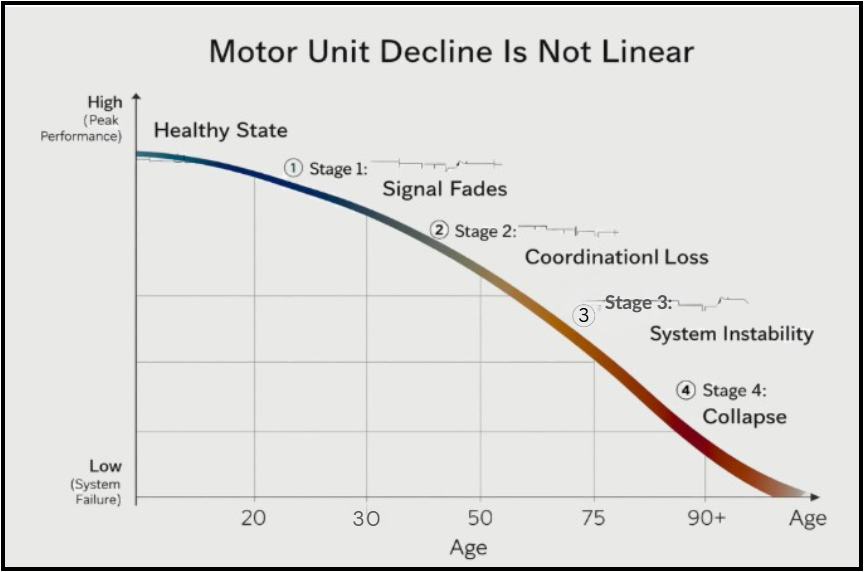
The Network Degradation Model reframes neuromuscular aging as a cascading systems failure rather than a series of isolated losses. This perspective shifts the focus from isolated muscular atrophy to preserving whole-system coherence.
The “Common Drive”: Why Your Brain Is Losing the Rhythm
One of the key reasons young people move fast, explosively, and with control comes down to something called Common Drive. This is the brain’s ability to send a single, synchronized signal to many motor units at the same time.
When this system is working properly, your muscle fibers do not fire randomly. They fire together, in rhythm. That coordination is what allows you to produce smooth, powerful, and efficient movement.
The importance of this system becomes very clear when you look at the research.
A landmark study by Klass et al. (2008) found something that most people would not expect. Older adults only showed about a 28% drop in maximum strength. But when researchers looked at how fast they could produce force, the drop was much bigger, about 48% in the rate of torque development.
This tells you something critical. The ability to generate force quickly, which depends heavily on signal timing and synchronization, declines much faster than muscle size or basic strength. In other words, the problem is not just the muscle. It is the signal controlling it.
As this synchronization starts to break down, the system begins to fall into what can be described as “signal chaos.”
- Healthy State: Neural signals are clean and synchronized. Motor units fire together in a coordinated way, producing strong and efficient movement.
- Fully Degraded State: The signals coming from the motor neurons become unstable. They fire at different times, out of rhythm, and without coordination. This creates jittery, disorganized output, and the body loses its ability to generate force properly, even if the muscle itself is still there.
This is why someone can still have muscle but feel slower, less explosive, and less controlled. The rhythm is gone.
The Local Training Trap: Why “Training Hard” Isn’t Enough
A lot of people believe that if you train hard enough, you protect your body from aging. But the data does not fully support that idea.
Research from Piasecki et al. (2019) shows what can be called the “Paradox of Master Athletes.” Training does help preserve motor units, but only in the exact muscles being used. A lifelong runner, for example, may keep strong and well-preserved motor units in their quadriceps, but other areas like the upper body and torso continue to decline as if they were never trained.
This creates a hidden problem.
When you focus only on certain muscles, the rest of the system begins to weaken in the background. These become what you could call silent weak points. You do not notice them right away because the muscles you train still perform well. This gives a false sense of security. You feel strong, but the overall network is no longer balanced.
Over time, this imbalance starts to affect the entire system. The body does not operate in isolated parts. Everything is connected through the nervous system. When one region begins to break down, it does not stay contained. It sends disruption through the rest of the network.
It is similar to what happens in other systems. If one part of a circuit fails, it can affect the entire electrical flow. If one part of circulation is blocked, it impacts the whole system. The same idea applies here. A weak, undertrained area can interfere with the common drive and coordination of the entire body.
So the issue is not just whether you train hard. It is whether you train the whole system.
The Five “Collapse Points” of Your Neuromuscular Grid
The Network Degradation Model points to five key control hubs in the body that act like bottlenecks for movement. When these areas start to weaken or lose motor units, the effects do not stay local. They spread through the system and begin to reduce overall control, stability, and coordination.
- The Pelvic Floor. This area works like a central switchboard for force transfer through the body. By around age 80, it can lose up to 50% of its muscle fibers. When this region weakens, it disrupts posture and walking mechanics, and it can trigger a larger breakdown across the system.
- The Neck Stabilizers. These are deep muscles that help hold your head and spine in proper alignment. Changes in aging can account for about 50% of the loss in muscle elasticity and stiffness, and this process can start as early as your 20s. When these stabilizers weaken, the entire system above and below them becomes less stable.
- The Rotator Cuff. These muscles control the shoulder and play a key role in connecting the upper body to the torso. Over time, they go through what is called silent degeneration, often involving fatty infiltration. As this happens, coordination between the arms and the rest of the body starts to break down.
- The Foot Muscles. These are small, often overlooked muscles, but they are essential for balance and preventing falls. When they weaken, the body loses a major point of contact and control with the ground, which affects movement as a whole.
- The Muscles of the Hand. In particular, the thenar motor units are important for fine control and dexterity. When these begin to decline, it reflects a larger loss of precise communication within the nervous system. Small motor control starts to fade, and that often signals deeper system-wide changes.
The Invisible Deficit: Your Best Muscle Fibers May Already Be Gone
A 2025 study by Cefis et al. shows just how early this problem can start, and it is not what most people expect.
Researchers took muscle samples from the vastus lateralis, one of the main muscles in the leg, and looked specifically at the fastest and most powerful motor units, known as Type IIx. These are the ones responsible for explosive movement, speed, and maximum power.
What they found was surprising. In people as young as 20 to 39 years old, these pure Type IIx motor units were completely missing. They were not just reduced. They were gone.
Instead, they had been replaced by something called hybrid Type IIa/IIx fibers. These are not as powerful or as fast. They are a kind of compromise. The system is trying to adapt, but it is doing so at a lower level of performance.
This matters more than it seems.
If your highest power motor units are already disappearing this early, it means you are not starting from a full system as you age. You are already operating with gaps. The network is being remodeled in a weaker form long before you feel any real decline.
So by the time you reach middle age, part of the system has already been downgraded.
This is why aging does not suddenly appear later in life. It begins much earlier, quietly, and in a way that most people never notice.
From “Hypertrophy” to “Connectivity”: The Case for Training Wide
To deal with this problem, the focus has to change. It cannot just be about building bigger muscles. It has to be about preserving the network that controls those muscles.
This is where the idea of Network-Focused Preservation comes in. Longevity depends on what can be called “training wider,” making sure the entire system stays active so the brain does not start adapting in the wrong way. Studies using fMRI (Heuninckx et al., 2005) have shown that when signals from the body weaken, the brain starts compensating by adding extra effort, almost like noise, to try to complete simple physical tasks. That is a sign the system is no longer efficient.
A proper Network-Focused Strategy should follow a few key ideas.
- Targeting the Neglected: You need to actively train the areas most people ignore, especially the collapse points like the pelvic floor, neck stabilizers, and foot muscles. These areas play a much bigger role in overall control than people realize.
- Prioritizing Signal Speed: It is not just about how much force you can produce, but how fast you can produce it. This is known as the rate of force development, or RFD, along with how quickly motor units are recruited. Speed of activation matters more than just tension.
- Embracing “Movement Chaos”: Training should include movements that are not predictable. Dynamic, complex, and reactive movements force the nervous system to stay sharp. This kind of “Movement Chaos” keeps the system adaptable and prevents the brain from settling into repetitive patterns that slowly weaken the signal over time.
Conclusion: Preserving the Music of the Motor System
Aging is not just your body slowly wearing out. It is the gradual loss of synchronization inside your system. What really breaks down is not just tissue, but the timing and quality of the signal coming from your brain to your muscles.
Real longevity is not about how big your muscles are. It is about how well that signal is still working. It is about how clean, fast, and coordinated the communication is between your brain and your body.
If you think of your body like a connected circuit, then your training has to protect the whole system. Not just the muscle, but the structure, the rhythm, and the way everything works together. This means moving beyond just building size and focusing on keeping your movement sharp, controlled, and connected.
At the end of the day, your body runs on signals.
The real question is simple. Are you training in a way that keeps that signal alive and working at a high level, or are you just building muscle and ignoring the system that controls it?
Keywords
neuromuscular aging, motor unit loss, fast motor units, motor neurons, common drive, rate of force development, Type IIx fibers, neuromuscular coordination, master athletes, whole-body training
References
- Cefis, M., Marcangeli, V., Hammad, R., Granet, J., Leduc-Gaudet, J. P., Gaudreau, P., Trumpff, C., Huang, Q., Picard, M., Aubertin-Leheudre, M., Bélanger, M., Robitaille, R., Morais, J. A., & Gouspillou, G. (2025). Impact of physical activity on physical function, mitochondrial energetics, ROS production, and Ca2+ handling across the adult lifespan in men. Cell Reports Medicine, 6(2), 101968. https://doi.org/10.1016/j.xcrm.2025.101968
- Heuninckx, S., Wenderoth, N., Debaere, F., Peeters, R., & Swinnen, S. P. (2005). Neural basis of aging: The penetration of cognition into action control. The Journal of Neuroscience, 25(29), 6787-6796. https://doi.org/10.1523/JNEUROSCI.1263-05.2005
- Klass, M., Baudry, S., & Duchateau, J. (2008). Age-related decline in rate of torque development is accompanied by lower maximal motor unit discharge frequency during fast contractions. Journal of Applied Physiology, 104(3), 739-746. https://doi.org/10.1152/japplphysiol.00550.2007
- Piasecki, M., Ireland, A., Piasecki, J., Degens, H., Stashuk, D. W., Swiecicka, A., Rutter, M. K., Jones, D. A., & McPhee, J. S. (2019). Long-Term Endurance and Power Training May Facilitate Motor Unit Size Expansion to Compensate for Declining Motor Unit Numbers in Older Age. Frontiers in Physiology, 10, 449. https://doi.org/10.3389/fphys.2019.00449
- Ruggia, T. (2025). Rethinking aging: A systems-based model of neuromuscular decline. OSF Preprints. https://doi.org/10.31219/osf.io/bgrj3_v1